 Burnby
Rowing Machine for Beginners: Who It Suits, Technique and How Long to Row
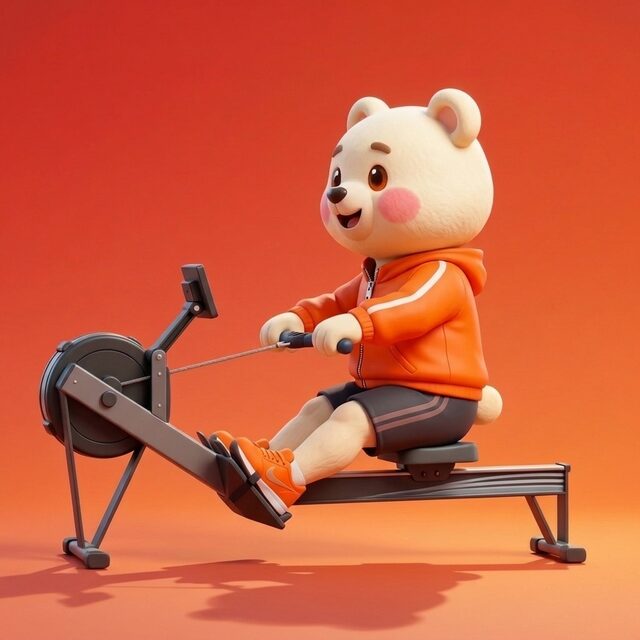
A rowing machine suits people who want low-impact cardio that uses the whole body. The power comes mostly from the legs, then the back and arms. Start with 5 to 10 minutes of easy rowing while you learn the stroke, then build up to 20 to 30 minutes at a moderate effort. Thirty moderate minutes burn roughly 150 to 190 extra kcal for a 70 to 90 kg person.
Who is the rowing machine a good fit for?
It is a good fit if you want to work your legs, back and arms together while sitting down, with no landing impact. It also suits people who like a clear number to follow: most rowers show your pace and distance for every stroke.
It is less of a fit if you have a current back problem, or if getting down to the low seat and back up is hard for you. Poor technique can strain the lower back, so take time to learn the stroke. If you have back pain, ask a professional first, or choose a bike or elliptical.
How do you row with good technique?
Each stroke has four parts. Concept2, a large rowing machine maker, describes the same basic order:
- Catch: sit tall, shins close to upright, arms straight, leaning slightly forward from the hips.
- Drive: push with your legs first. Then lean back a little. Then pull the handle to just below your ribs.
- Finish: legs straight, slight lean back, handle at your lower ribs, elbows past your body.
- Recovery: the same in reverse: arms away, lean forward from the hips, then bend the knees and slide back.
A simple way to remember it: legs, body, arms on the way out; arms, body, legs on the way back. The recovery should take longer than the drive.
How do you start in the first weeks?
| Week | What to do |
|---|---|
| 1 | 5–10 minutes of easy rowing, focusing on the order of the stroke, 2–3 days |
| 2 | 10–15 minutes; 2–3 blocks with short rests are fine |
| 3 | 15–20 minutes at a steady, moderate effort |
| 4 and later | 20–30 minutes or more |
Keep a steady, unhurried rhythm. Rowing faster is not better if the stroke gets short and choppy.
How hard should rowing feel?
Use the talk test: you can speak in short sentences but could not sing. Most of the effort should come from pushing with the legs, not from pulling with the arms.
The damper lever on the side is not a difficulty setting. Concept2 explains that it changes how the stroke feels and suggests starting at 3 to 5. How hard you push decides the effort. A high damper setting tires the back and arms quickly.
What heart rate should you aim for on the rower?
Rowing uses your legs, back and arms, so your heart rate can climb almost as high as when running. It usually rises slowly over the first few minutes, so do not row harder early just to reach the range. The effort comes from how hard you drive each stroke and how many strokes you take a minute, not from the damper. A steady 20 to 24 strokes a minute is a common pace for moderate sessions.
| Age | Moderate | Vigorous |
|---|---|---|
| 20 | 100–140 bpm | 140–170 bpm |
| 30 | 95–133 bpm | 133–162 bpm |
| 40 | 90–126 bpm | 126–153 bpm |
| 50 | 85–119 bpm | 119–145 bpm |
| 60 | 80–112 bpm | 112–136 bpm |
| 70 | 75–105 bpm | 105–128 bpm |
The ranges use 220 minus age, as the American Heart Association does: moderate is about 50 to 70 percent of that maximum, vigorous about 70 to 85 percent. They are averages, and your own numbers can differ by 10 beats or more. If the number and your breathing disagree, trust your breathing. The cardio guide has the full table and when these ranges do not apply.
How many minutes of rowing balance a meal?
Burnby uses the 2024 Adult Compendium of Physical Activities row for a rowing machine at moderate effort, under 100 watts: 5.0 MET (code 02071). The Compendium has no lighter rowing row, so Burnby uses the same value for easy and moderate sessions. It counts only the energy on top of what you would burn at rest anyway (net calories).
| Food | 70 kg (154 lb) | 90 kg (198 lb) |
|---|---|---|
| 250 kcal snack | about 51 min | about 40 min |
| 600 kcal meal | about 122 min | about 95 min |
These are estimates, and Burnby shows a range around each number. Vigorous rowing burns more. You do not have to row off each meal: Burnby looks at your whole day and only the gap to your goal becomes minutes.
What do you need, and how do you stay safe?
- Feet: strap them in across the widest part of the foot.
- Clothes: fitted shorts or leggings that do not catch on the seat rail.
- Water and a towel: rowing is sweaty.
- Back care: keep your back long and hinge from the hips, rather than rounding forward to reach.
Stop and get medical help if you feel chest pain or pressure, dizziness, faintness or unusual shortness of breath. Stop if a movement causes sharp back pain.
What are common mistakes?
- Pulling with the arms first. The legs should start every stroke.
- Rounding the back. Sit tall and lean from the hips.
- Damper at 10. It does not make the workout better, just heavier. Start at 3 to 5.
- Rushing the recovery. Slide forward slowly; the drive is quick and the return is relaxed.
- Rowing too long at first. Ten good minutes are better than thirty with poor form.
How do you get more out of rowing?
- Drive with your legs. Most of the power comes from the legs; then the body swings back, then the arms pull.
- Come forward slowly. Take about twice as long sliding forward as pulling back. It gives you a moment of rest in every stroke.
- Watch the split or the watts, not only the time. A faster split at the same breathing means you are getting fitter.
- Add intervals once 20 minutes feels steady: for example 1 minute firmer, then 1 to 2 minutes easy, 5 to 8 times.
- Sit tall at the finish. Lean back only slightly and keep your wrists flat, which protects the lower back.
How does rowing fit with Burnby?
Log each session as rowing machine. It uses more energy per minute than walking, so your daily minutes are shorter. You can get your own plan in a couple of minutes.
This article is general information, not medical advice. If you have heart, lung, back, joint or metabolic problems, or are pregnant, talk to a doctor before you start.
FAQ
Is a rowing machine good for losing weight?
It is a good way to use energy without impact, and it fits into Burnby like any other cardio. Weight change depends on the whole day, including what you eat.
Is rowing bad for your back?
Rounding your back while you pull can strain it, so keep your back long and let the legs lead. If you already have back pain, ask a professional first.
What damper setting should I use?
Start at 3 to 5, as Concept2 suggests. It changes the feel, not the effort.